Sunday, July 8, 2012

You say Goodbye...

I say Hello. Hello Hello. ...

The VSO experience is a constant series of goodbyes and hellos. Every 4 months a new batch of volunteers arrive fresh off the plane. And consequently their arrival usually heralds the departure of other volunteers whose time in Kenya has come to an end.

Having been in Kenya 8 months I've made lots of new friends. And now, just as I'm getting to know them properly, they're up and leaving me. This month alone I'll be saying goodbye to my housemate Barbara, my friend Annie, and Helen and Dan (who have a very good blog here) And last month we lost Eddie and Allys. And before that I had to say goodbye to my housemate Sandy.

This is the sad part about VSO. You bond with people over shared successes and frustrations. You celebrate birthdays, Christmas, St Patrick's Day. You go on adventures. You see giraffes. And then they're gone.

On the flipside I do get to make new friends every 4 months. I've made sure to help out at the In-Country Training (ICT) for the 2 batches of VSO volunteers that have come after me (in March and most recently this weekend) in order to do so. I've helped to deliver presentations on what to expect as they begin this process. I've led town tours of Nairobi. I've doled out useful advice on how matatus work, how to charm postal officials so that don't charge import duty, where the cheapest fruit and veg are to be found. I've been friendly (I hope!). But making new friends can be exhausting, especially when you know that in a year's time they'll be gone, maybe even before that. And since my intention is to remain in Kenya for more than a year, if at all possible, I do wonder sometimes if it's worth it.

The answer is, 'of course it is Andrea!'. The VSO experience is just a compressed version of life, where friends are made and lost over time. I have met some incredible people in these past 8 months and I wouldn't have swopped the pints, and the parties, and the adventures for the world. And even if and when they do leave me sure 'we'll always have Kenya'. That is the line, isn't it?

Related Articles:

Thursday, June 28, 2012

Reflections of an emigrant...

I am Irish but I live outside of Ireland. I am one of approximately 1 million Irish-born people who can make this statement today. (Although there are up to 70 million diaspora worldwide if you count second- and third-generation Irish).

When I get the time I do read about other Irish people living abroad. A lot of what is written about Irish emigration is inherently depressing in character. The Irish media for a number of months, especially in 2010 and 2011 was obsessed with those leaving the country and there were countless newspaper articles, radio reports and TV documentaries in this vein. Initiatives like the Irish Times' Generation Emigration section have gone someway to redress the balance of coverage. The micro-site publishes stories of Irish emigration from all over the world, it has spaces for people to tell their own stories of life in the U.S., Australia, South Korea or wherever they find themselves. The articles tend to present a mix of experiences, ranging from those who were happy to leave Ireland and live and explore other countries, to those who feel their departure was  involuntary, forced by economic or other circumstances. Emigration is always a hotly debated topic, and always generates strong opinions when brought up.

The Irish Times comprehensive survey published a couple of month backs up what I had already suspected about a lot of recent Irish emigration. Firstly 72% of those questioned were working before they emigrated showing that it's not just those that are unemployed. In reality, it's probably harder for those who are unemployed to emigrate in many cases, as setting up in a new country is not cheap. Related to that, 75% of those interviewed said that their current job was better than the one they had previously held in Ireland compared to 14% who said it was about the same and only 10% who said it was worse. People aren't going abroad simply for jobs, they are going abroad for better jobs, better opportunities. Older emigrants were far more likely to have a job lined up before moving, 57% of over 35s had work lined up compared to 29% of under 25s. This makes sense, as they are more likely to be moving with partners or families in tow.

These statistics reflected my own, and many of my friends' experiences of emigration. For me, I moved abroad first for study, and then for this volunteer/work experience. I probably could have found work at home, but it would not have been in the area I was interested in. I saw moving away as a chance to gain valuable experience that would have been difficult to get in Ireland.

Some of the statistics I found most interesting referred not to people's new jobs but to their new lifestyles. 70% said their new lifestyle was better, with only 10% saying it was worse. 55% stated that their diet was better than back home, and 54% were exercising more. Drinking habits were fairly unchanged, with 42% drinking about the same, 35% drinking less and 22% drinking more. Overall, those who stated they were happier made up 56% of the sample, 22% were less happy and 22% were about the same.

I myself am definitely living healthier in Kenya than I did in Ireland; in many ways my lifestyle is better than it would have been at home. I eat far more fresh fruit and veg, and far less meat and processed foods. I cook proper meals, far more often than I would if I lived in Ireland. I am also drinking less than I would be in Ireland. All of this has been a great by-product of having to get by on a volunteer's allowance and I hope to continue whenever I do go home.

I also dedicate a lot more time to friends and family relationships here than I probably would do at home. I don't physically see most of them but we email, Skype, Facebook, tweet, send Whatsapp and Viber messages. I actually ring my granny more often here than I did when I lived in London. Being away from Ireland has highlighted the importance of nurturing these key relationships in my life, which can be no bad thing.

I fully intend to go to Ireland some day. But I am just not sure what day that will be, nor quite what it will take to fully lure me back. I miss Ireland. And I miss my friends and family dreadfully. But not quite enough to get me to move back without knowing that certain job, career and lifestyle prospects would be waiting for me.

My good friend Órla reminded me of a beautiful Irish blessing recently 'Sláinte, saol fada agus bás in Eirinn'. For the non-Irish speakers amongst you this translates as wishing for 'Health, long life and may you die in Ireland'. That's what I wish for all of my Irish friends, and a few of my non-Irish ones too.

Related Articles:

Sunday, June 24, 2012

Ex Africa Semper Aliquid Novi

Out of Africa always comes something new. 

I came across this phrase in a book, The Zanzibar Chest, that I read for a book club I've recently joined. The utterance, which is often attributed to Pliny the Elder but in reality it has its origins in a far older Greek phrase, struck a chord with me. Despite having been said hundreds of years ago it is as true now as it was then.

I think of the technological innovations that have come out of Africa in recent times. I have spoken about them in an earlier blogpost but innovations such as M-Pesa and Ushahidi are ingenious solutions to African problems which have since found use across the globe.

There are other innovations beyond the technological. At the TED talk I attended back in May speakers spoke of new ways to tackle environmental concerns, agricultural difficulties, wildlife . Entrepreneurial spirit is alive and well in Africa, there is no question of that.


Pliny's phrase also connected in my head to the advertising campaign that Coca Cola have started here in recent months - 'A Billion Reasons to Believe in Africa'. All across the city Coca Cola have erected billboard proclaiming this phrase with pictures of good-looking Africans playing sports, performing, pushing cars up dusty roads...


An ad on the radio, which I can almost recite verbatim thanks to the frequency of its broadcast, tells us: 'There are a billion reasons to believe in Africa. While the world shakes and stumbles, Africa dances to a different beat .1 in 5 players in European clubs can trace their roots to Africa. The world's most admired man is African. While the world worries about the future, 1 billion Africans are sharing a Coke.' (There's also a TV ad version here.)

Both Pliny the Elder and Coca-Cola are espousing the same message, in my opinion, albeit for very different reasons. They talk of the vibrancy of Africa, the innovation, the creativity, the spirit, the dynamism, the hope. I can only really speak of Kenya but the place is constantly in motion. You can accuse Kenya, and Africa, of being many things, but being boring certainly isn't one of them. There are countless opportunities for change here, whether the change is for the better or worse is another matter entirely.

I think that's why, 8 months into my time here, Kenya and Nairobi still excite me. And why I feel like I don't want to leave any time soon. The next year holds many new possibilities for Kenya. Elections in March will be the first test of the new constitution and the opportunity to prove that the unrest of 2007/8 need not be repeated after every election here. The ICC trials of prominent accused organisers of that violence which will seek to find answers and justice in the backdrop of the elections. I don't know what Kenya will look like this time next year, but I really hope I'm here to find out.

Related Article

Saturday, June 23, 2012

Things I've Learned in Kenya - Part 4

Matatu Stages are displays of Market Economics at its most pure

I know very little about economics. And it's something I always lament. I am often heard to say 'I wish I knew more about economics'. It would probably help me decide whether or not to head back to Europe in a few months.

Thanks to Professor P.J. Drudy and 'Introduction to Economic Policy' way back in my Junior Freshman year of Trinity I do know the (very) basics . Like supply and demand and how that interaction determines prices in a pure market economy. And last Tuesday waiting at the matatu stage I saw Professor Drudy's lectures come to life.

The matatu stage at the bottom of UN avenue (yes, it's really called that) was packed and there wasn't a matatu to be seen. Which is very unusual. On most occasions when I get to that stage there are a couple of matatus waiting and I have a chance to pick the one that is offering me the best seat. But that day there were about 40 people waiting and no sign of any transport coming. We waited, and when one eventually came it was chaos. Everyone ran towards it until the conductor shouted the price. 60 bob into town. 60 bob! It's normally 30 bob. At that point more than half the people slunk away, including myself, unwilling to pay that price. But the conductor found 13 people more than happy to pay it and off he went. Another matatu pulled up and the same thing happened. So the crowd had thinned. A third matatu pulled up trying to charge 50 and  the people that we left were having none of it. A few got on but most people stood where they were. After a minute or two the conductor shouted 'town, town, 40 bob' and the matatu filled up in seconds. This third conductor wasn't facing the high level of demand that the first two had and so had to adjust his prices accordingly.

Actually these displays happen everyday. When I pick up a bus or matatu at Westlands for the last leg of my journey home it often takes me a few minutes to get on one. Not that there's not many matatus going in my direction, it's just that they're charging me more than I want to pay. So I shop around, ask a few different conductors until finally I find one that's charging 40 shillings as opposed to 60 shillings. It's a 20 bob difference but it's all part of everyday life here in Kenya.

My fervour for sports and dressing up only increases the further from Ireland I go


This isn't something I've learned about Kenya, but it's something I've learned *in* Kenya about myself, so it still counts. Sort of.

I love a good sporting occasion. Preferably one where country or county pride is involved. When I'm in Ireland I try to go to as many Meath matches as I can. I have been known to wear bright green tights to these matches, as well as a skirt and my jersey. On one occasion I wore two pairs of tights, one yellow, one green, with a leg in each. I am *exactly* that cool. I was once asked by a steward in Croke Park, an elderly gentleman shall we say, whether my stockings (the green tights) went 'all the way up'. Shudder. When my brother's school was in the Leinster final in Gaelic football I wore amber coloured tights with black patterned tights over them so I would be the right combination of black and amber.

Since I can't watch GAA here in Kenya I was excited about the prospect of getting into some good sporting spirit during the Euros in support of Ireland. So off in search of an Irish jersey I went. I mentioned in an earlier blogpost that donated clothes from Ireland make their way over to Kenya and other African countries and end up getting sold in second-hand clothes markets. I'd seen Kenyans wearing Irish soccer jerseys before and didn't think I'd have any problems picking some up. My friend Kristen who accompanied me to the market on the Sunday morning in question was sceptical that I would find what she imagined would be a rather rare commodity. Within 20 minutes I had found 4 retro Irish soccer jerseys and so I had my pick of the best two for Amy and I. The price I paid for them? 450 shillings, about €4.30.


My haul from the second hand market.
One for me, and one for Amy.
Jerseys bought  it was time for the rest of the outfits to be put together. Luckily I had some of the temporary tattoos left over from St Patrick's Day and some of the flags I had acquired (nicked) from the tables at the Irish Ball so we left for the pub delighted with ourselves.

Dressed and ready for some 'COYBIG' cheering

Hardcore supporters.

When we arrived at the pub we were the only people wearing jerseys. The only people. A little embarrassed by our enthusiasm we took seats at the bar near one of the smaller screens to watch the Spain Italy match. Almost everyone that passed us did a little double take to see the two girls up at the bar completely decked out in green, white and gold. Most smiled at us. Some looked a little embarrassed for us. Once the Ireland game started and some of our friends arrived I like to think that we didn't look quite as odd but I'm sure we did.

Now I didn't lick this enthusiasm off the stones. I place the blame for this fervour on my mother.

Exhibit A) Our family at a match supporting my little brother when he was playing football for his school. Notice Mammy Wickham's yellow jumper and black trouser combo. What you can't see is the yellow and black socks she is sporting, I kid you not.

The Wickham family - never ones to shy
away from an occasion to dress up.

Mum loves dressing up. She wears a uniform at work but even still she manages to dress up. If Meath get to a certain advanced stage of the All Irelnad Championship she will paint her nails green and yellow. At Christmas she wears Christmassy earrings, mistletoe, flashing Christmas trees etc. At Hallowe'en she'll sport pumpkin earrings. My mother is a little bit cracked and I absolutely love her for it. And I love that I seem to have inherited it.


Men in Kenya and the Carly Rae Jepsen method of picking up women


Many of you may not know who Caryl Rae Jepsen is. And if you are over 15 that is understandable (if not wholly forgiveable). For those of you who are older than the average Belieber Carly Rae Jepsen is a Canadian singer who released a song called ‘Call Me Maybe’ late last year. The song received some airplay and a few hits on YouTube. However when Justin Bieber, Selena Gomez, Ashley Tisdale and lots of their Disney Clubber mates made this video the song went viral. Fast. To be fair it is a rather catchy poppy tune but it once again shows the awesome power of tweenagers and the internet.

Anyways, the reason I bring it up is to do with the song’s lyrics. Jepsen sings

‘Hey, I just met you.
And this is crazy.
But here’s my number.
So call me maybe.’

This appears to be how many of my interactions with random Kenyan men go. Except instead of giving me their number they insist they would like to have my number because they think I am interesting/beautiful/insert insincere platitude here despite having met me only seconds earlier. In the past couple of weeks small talk conversations on buses, matatus, at a work conference for religious leaders (!), queueing for takeaway coffee have all led to requests for my number. This is not new. It has happened since I arrived in Kenya but I am getting increasingly confident about saying 'I'd rather not'. Though I will admit I have given a wrong number out on a few occasions too. Or my latest trick is to make up an imaginary partner and laugh out the request with a casual ‘oh well now, I’m not sure how happy my partner would be about me giving my number to other men.’ That usually (but not always) does the trick. 

As annoying as this gets will I miss it when I'm back home? The attention? The flattery, exaggerated as it is? It's going to be very strange going back to a place where I no longer stick out all the time, where I blend in, where I look like everyone else.


Also in this series:

Thursday, May 31, 2012

In the companies of elephants, princes and VSO volunteers


A couple of weeks ago I got the opportunity to go on a weekend away with 20 other VSO volunteers. Which would be a great weekend under normal circumstances. But this was a special weekend. This was the ‘Il Ngwesi weekend’. It was an event that other volunteers had spoken about in hushed, almost revential tones. It was ‘magical’ they said. ‘One of the best weekends we’ve had in Kenya’ ‘unmissable’. On and on they went. So when an email was sent around inviting people to sign up I replied within seconds (from under the desk of the workshop I was at).

I should probably explain what this elusive ‘il ngwesi’ thing is all about. Well Il Ngwesi is the name of a Maasai community of people who live near Isiolo in Northern Kenya. These people live in one of the most beautiful conservancies I have ever seen and about 10 years ago they set up their own exclusive (and rather expensive) eco-lodge to allow people to stay right amongst the wildlife and game.

The journey to the Eco-Lodge

Our journey officially began from Nairobi at 8am on Friday morning where we hopped into hired matatus to take us to Nanyuki (for a spot of lunch) and on to the gate of Lewa conservancy. This is where the real journey to the lodge began in my eyes. We spent nearly 3 hours driving through gorgeous scenery on the back of jeeps, spotting elephants, giraffes, rhinos (from quite far away) and many other things besides.


What's over there?


Or there?

Giraffes - my favourites.

The Lodge itself

Tired after a long - though fruitful in terms of animals spotted -game drive we arrived at the lodge. And previous reports had not exaggerated the beauty of the lodge itself. The place consists of 6 different cottages all tucked in to various sides of the hills. All of the cottages opened out on different views of the bush and we woke up both morning to see elephants and giraffes making their way to the watering hole.

Each part of the lodge was beautifully designed, as you can see in the pictures below, in a way that makes them almost look like they are part of the environment around them.
Open cottages. I could see
giraffes without having to get out of bed.


Showering in full view of the wildlife (the poor wildlife)

'A Loo with a View' - the oft forgotten sequel
to the 1985 classic film 'A Room with a View'


Chilling in the infinity pool


 Close encounters with elephants

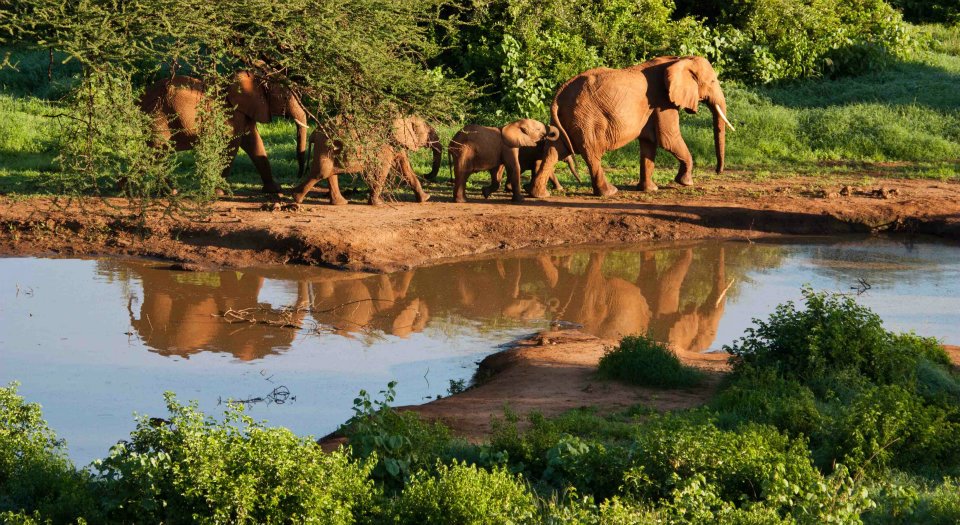
We woke before sunrise on Saturday morning in order to grab coffee and biscuits before our bush walk. As I got my caffeine fix we watched a herd of elephants observe their own morning routine. 

Elephants down by the watering hole early in the morning

A close-up of the elephants - thanks to Simon Dixon
and his amazing camera for this photograph


Lion print! Sadly I have still yet to see lions in Kenya
And then off we went with our guide to walk through the park in the hope of spotting some animals up close. Well not too close. We had two armed guards with us to make sure that we never in any danger of getting into any trouble with an angry mammy elephant.


Peeping at elephants on our early morning bush walk
Our guide explains to us about the various animals
while the armed guard listens from the back

What was the food like I hear you ask?

Amazing. Absolutely yummy. We were so well fed throughout the weekend. There was even a cheeseboard at lunch one of the days. A cheeseboard! However my favourite meal of all was our outdoor breakfast after our bushwalk on Saturday morning. Under the trees and not far from where we'd earlier been spotting elephants and giraffes we tucked into a breakfast complete with cereals, fruits and most of the constituents of a full Irish - all it was missing was the pudding!


Full fry buffet in the middle of the bush


Omelette, rashers, saugages, fried potatoes, beans, toast.
Breakfast of champions.


Maasai lads enjoying their cuppa...


...Though not half as much as I did

Famous past guests

Before leaving on Sunday morning I took the time to browse through the guest book for some of the famous names that I had heard shad stayed at Il Ngwesi before us. And I was not disappointed.


William Wales - aka Prince William!

Catherine Middleton - the Duchess of Cambridge

Related Articles:

Tuesday, May 29, 2012

A trip out West...

Travelling in style

I awoke at silly o'clock last Monday morning for my latest field trip to Kisumu in Western Kenya. Why so early? Because I was FLYING to Kisumu! Kisumu is about an 8 hour drive from Nairobi (give or take a few hours) but UNICEF being UNICEF my colleagues Roselyn, Nande and I were flying there. Taking a plane felt a little indulgent since many of my VSO colleagues regularly make that trip by road but the second the nice Kenya Airways stewardness handed me my complimentary nuts and juice I thought 'feck it' - let's enjoy this while I can.

The downside of flying is that you don't get to see the countryside between Nairobi and the West. But luckily my work for the few days was mostly outside of the city of Kisumu in places like Siaya, Rongo and Homa Bay. A few days squished into the back of a landcruiser meant I got to see some of what Western Kenya has to offer.


Lovely lush green countryside.

Unlike Garissa -the site of my last trip away with UNICEF - Western Kenya, and Nyanza province in particular, has had plenty this rainy season. In fact parts of Nyanza have experienced severe flooding in the past couple of weeks with hundreds of people left homeless from floods and landslides. Kenya overall has been pretty badly hit by extreme weather during the long rains. More information can be found here, and here.

Flooding as seen on the way to visit one of the health facilities


eMTCT

The purpose of the trip was to do some field research and monitoring of eMTCT activities. eMTCT, to recap for new readers, stands for the Elimination of Mother to Child Transmission of HIV. I have absolutely know idea why the 'e' is small but it appears that way on lots of official documents so I'm going to stick by the apparent convention. UNICEF, along with UN agencies partners such as UNAIDS and UNFPA, government partners, and NGO partners are about to launch a new national eMTCT framework, and a Communication Strategy to match. The aim is to reduce transmission rates in Kenya to below 5% by 2015. It's an ambitious target, but it's in line with global commitments set by UNAIDS and is in line with Millenium Development Goal targets for Maternal Mortality and HIV/AIDS. According to figures from 2009 the rate of transmission from mother to baby stood at 27% when the babies were tested for HIV at 18 months. So Kenya has a long way to go, and fast.

As I may have mentioned before eMTCT is probably the only HIV/AIDS intervention in which the funding is actually growing rather than shrinking. It has been identified as an area that is, for want of a better phrase, 'an easy win'. Thousands and thousands of infections can be prevented every year if simple steps are taken by pregnant mothers and their partners. These include getting HIV tested with your partner, attending at least 4 Ante-Natal Clinics (ANC), delivering the baby in a health facility and breast-feeding exclusively for 6 months.

Also, who doesn't want to fund babies?


A Kata Shauri poster on the door of
Rongo District Hospital -
not quite hanging 'pride of place' but still

Back in 2010 UNICEF Kenya and goverment partners launched a communication campaign called 'Kata Shauri' to promote key PMTCT messages (prevention of...). Kata Shauri means 'to make a decision' and the campaign asked people to make a decision to protect their children (the subtitle to the campaign was actually 'Tulinde Kizazi' which means to protect generations so the full message was 'Make a decision to protect the generations'). In light of the new eMTCT agenda we are in the process of updating the campaign but to do that we wanted to speak to the nurses, health promotion officers and community health workers who are engaged in these activities and who spread these messages everyday.

We went to visit district hospitals and health faciltiies in key places which have been identified as areas with high prevalences of HIV/AIDS and consequently high transmission rates. In the areas we visited we heard some of the same challenges to eMTCT repeated over and over again. These included the difficulty in getting men tested and involved with ANC visits, the reluctance/inability of women to exclusively breastfeed for 6 months, the high drop-out rates from ANC clinics etc... But individual health centres also told us interesting stories. The one that stuck with us most was that of the 'mentor mother' challenges.


The Mentor Mother Dilemma

Mentor mothers are HIV positive women who provide support, counselling, and a friendly face to HIV positive pregnant women who are going through Ante Natal Care while getting diagnosed and beginning treatment for HIV. Organisations like Mothers 2 Mothers have shown that the scheme can be very effective in reducing rates of transmission to babies, but more broadly in helping HIVpositive women to live healthier lives. The idea is that nurses and health workers have very little time to dedicate to individual patients so these women take some of the burden from healthcare workers too. The Kenyan government have been so impressed with the results that have come from the scheme that they have just launched a nationwide version called the Kenya Mentor Mother Programme.

Mentor mothers are meant to be based within health centres to provide their services but some places have been using them for defaulter tracing. This is where they go out in the community to track down women who have missed their scheduled ANC or other appointments (a job usually done by Community Health Workers). However, while most mentor mothers have disclosed their HIV positive status to the community many of the women they work with have not. So by seeking out women to check why they have missed a check-up they are unintentionally disclosing their status and therefore possibly stigmatising these women within their community. We have taken this feedback to our government partners and so we hope that there will be more guidance put in place as to how mentor mothers can help to support HIV positive pregnant women without potentially opening them up to discrimination in their community.


Mentor mothers wearing their Kata Shauri aprons

I found the visit overall to be extremely beneficial. There will be a direct benefit to my work as I understand more deeply what is actually involved in eMTCT. It has gone from being words on the high-level policy documents that I read to being something more tangible. Something that affects real women and children every day. Statistics about defaulters and drop-out rates make far more sense when I have seen the over-burdened health facilities, the dedicated but over-stretched health workers and the distances many women need to travel to seek help. On a more personal level every new part of Kenya helps me to understand the country more. I learn more about different tribes (this time it was the Luos) different cultural practices etc.


So long and thanks for all the fish
It wouldn't be a proper blogpost if I didn't mention food at some point. So let me talk briefly about the fish. As Kisumu is on Lake Victoria there is an abundance of yummy fish to be found there. And as the Luo people are well used to eating it they know how to cook it well. For lunch on the second and third day we headed to what Roselyn referred to as 'Car Wash'. Car wash is indeed where cars are washed and I wish I had taken a photo of the men driving cars into the lake in order to wash them. Not far in mind you. But it's also home to a string of about 12 restaurants, all serving roughly the same food, in similar surroundings. We settled on eating at 'Lakeside Hotel' and we were not disappointed.

A feast of fish and ugali

Samuel - my VSO colleague in Kisumu -
thrilled at the prospect of our lunch

Fish before

Fish after
As our office, in conjunction with partners, continue to push eMTCT I hope to make similar visits to areas where we are focusing on elimination and keeping mothers alive so I will be sure keep you all posted.

Happy out by the lake

Related Articles: